PARKHURST NUVISION
iDose TR
Travoprost intracameral implant
Gurpal Virdi, MD
Glaukos · FDA-approved Dec 2023 · U.S. launch 2024
The problem drops don't solve
iDose TR is a pillar of "interventional glaucoma", moving from drops to procedures earlier
- Adherence. Roughly half of glaucoma patients aren't taking drops as prescribed within a year.
- Preservative toxicity & ocular surface disease. Chronic BAK exposure drives redness, burning, and unstable tear film.
- Prostaglandin-associated periorbitopathy (PAP). Orbital fat atrophy, deepened sulcus, lash changes.
- The pitch: a one-time, in-office implant that removes the daily-drop burden while it works.
Parkhurst NuVision
Gurpal Virdi, MD
What it is
- Titanium implant, 1.8 × 0.5 mm, smaller than a grain of rice.
- 75 mcg of preservative-free travoprost held in a reservoir.
- Elutes continuously into the anterior chamber by membrane-controlled diffusion, steady drug level, no daily dosing.
- Implanted through the trabecular meshwork and back wall of Schlemm's canal, anchored in scleral tissue.
1.8 × 0.5 mm
Titanium reservoir implant
75 mcg
Preservative-free travoprost
Continuous
Membrane-controlled elution
Glaukos · FDA-approved December 2023, U.S. launch 2024.
Parkhurst NuVision
Gurpal Virdi, MD
Travoprost & the prostaglandin analogs
- Travoprost is a prostaglandin F2α analog, same class as latanoprost, bimatoprost, tafluprost, and the most potent topical IOP-lowering class (~25–33%).
- Prodrug → FP-receptor agonist. Corneal esterases convert it to travoprost free acid, which lowers IOP mainly by increasing uveoscleral outflow.
- Delivery is the differentiator, not the molecule, efficacy across PGAs is broadly similar; iDose changes how the drug is delivered.
- Preservative-free, intracameral, negligible systemic exposure, plasma travoprost stays below the assay limit (<10 pg/mL); it bypasses the ocular surface.
Fewer surface & cosmetic effects than drops: much less hyperemia, and trials saw none of the iris / periorbital pigmentation typical of topical PGAs, though the label still lists possible, likely-permanent iris pigmentation.
Source: iDose TR prescribing information (Glaukos), 1/2026.
Parkhurst NuVision
Gurpal Virdi, MD
How it goes in
- Clear corneal incision, aseptic conditions, in-office or OR.
- Delivered across the angle and anchored at the iridocorneal angle.
- Gonioscopy-visible, confirm position at the slit lamp.
- Standalone or combined with cataract surgery.
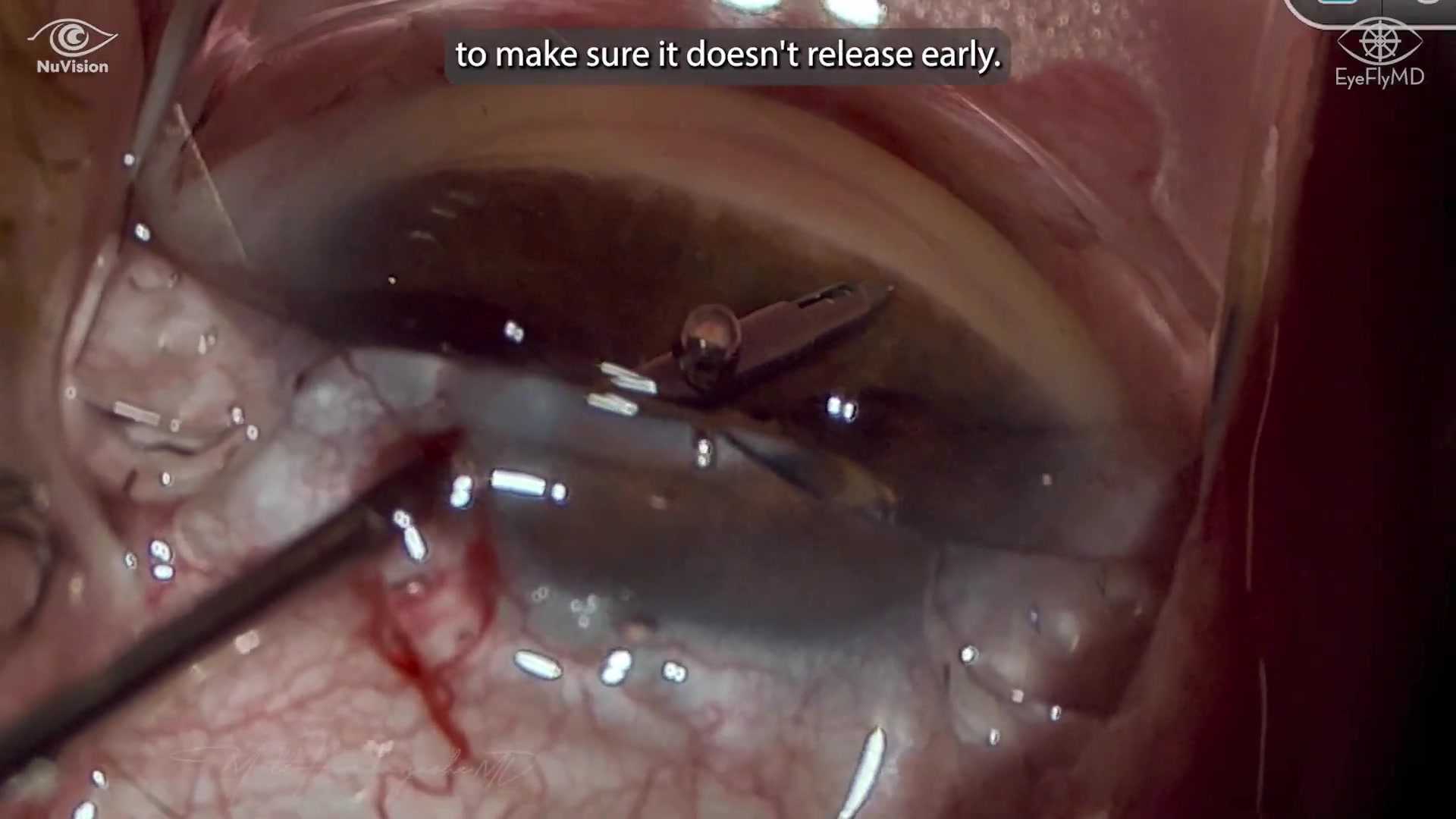 ▶
▶
Implantation across the angle, watch on YouTube
Parkhurst NuVision
Gurpal Virdi, MD
Who it's for
- Mild-to-moderate open-angle glaucoma or ocular hypertension needing better IOP control.
- Patients with poor adherence or intolerance to topical drops.
- Ocular surface disease, dexterity limits, or cost barriers to daily drops.
- Can be performed with or without cataract surgery.
Parkhurst NuVision
Gurpal Virdi, MD
Contraindications & cautions
Contraindicated
- Active or suspected ocular / periocular infection
- Corneal endothelial dystrophy, Fuchs, guttata
- Prior corneal transplant or DSAEK
- Hypersensitivity to travoprost
Use caution / counsel
- Narrow angles or angle abnormalities
- Monitor routinely to confirm implant position
- Iris pigmentation can occur, likely permanent
- MRI conditional, a handy practical pearl
Why the corneal ones: the implant sits by the corneal endothelium, Fuchs/guttata and prior grafts have too little endothelial reserve to absorb further cell loss.
Sources: iDose TR HCP prescribing information; Glaukos.
Parkhurst NuVision
Gurpal Virdi, MD
Re-administration is now approved
- FDA approved a labeling supplement allowing re-administration in the same eye, the old label said don't re-dose.
- Requires specular microscopy: the eye must meet an age-based minimum endothelial cell density; re-dosing is withheld if there's ≥10% ECD loss or prior device dislocation.
- No more than once per year.
- Backed by no clinically significant endothelial cell loss through 3 years across the phase 3 / 2b studies.
- Exchange study: place the new implant first, then remove the old one, safe and tolerated over 12 months.
Sources: Glaukos; PentaVision. FDA approval Jan 28, 2026.
Parkhurst NuVision
Gurpal Virdi, MD
Where iDose sits in sustained-release glaucoma
| System | Drug & format | Duration | Status |
|---|---|---|---|
| iDose TR | Travoprost, titanium, non-biodegradable, re-dosable | Label ~3 yr | FDA approved 2023 |
| Durysta | Bimatoprost, biodegradable intracameral | ~3–4 mo | FDA approved 2020 |
| OTX-TIC | Travoprost, biodegradable hydrogel | 4–6 mo | Phase 3 (missed endpoint) |
| ENV515 | Travoprost XR, biodegradable | ~6 mo | Phase 2a |
| SpyGlass | Bimatoprost, drug-eluting IOL pads (at cataract) | Up to 3 yr | Phase 1/2 |
Takeaway: iDose & Durysta are the only FDA-approved intracameral implants, iDose is the only non-biodegradable, re-administrable one, giving it by far the longest duration.
Investigational agents shown for context; landscape per published reviews.
Parkhurst NuVision
Gurpal Virdi, MD
How iDose fits our MIGS toolkit
| Option | Indication | On a med? | IOP drop | Notes |
|---|---|---|---|---|
| iDose TR | Mild–moderate OAG + ocular HTN | Not required | ~20–25% | Continuous travoprost; can get OHT / one-med patients off drops |
| iStent Infinite (3 stents) |
Mild–moderate OAG | Required, must be on a med | ~15–20% (if lucky) | Not for ocular HTN; best when noncompliant or poor ocular surface |
| OMNI | Ocular HTN + mild–moderate | Not required | Largest drop | Usually 2+ meds / more moderate disease; ↑ hyphema & cyclodialysis-cleft risk → historically after iStent |
| ECP | Closed-angle cases | - | - | For closed angles; also driven by insurance coverage |
Parkhurst NuVision
Gurpal Virdi, MD
What we see in clinic
- iDose, for ocular hypertension or a one-med patient, we can often get them off drops entirely. Labeling supports ~3 years; in our hands we typically see ~2 years of effect.
- iStent, anecdotally a temporary drop holiday, but many are back on a drop within 1–2 years.
- OMNI gives the biggest IOP reduction, we reserve it for 2+ meds / more moderate disease, and historically place it after iStent given higher hyphema and cyclodialysis-cleft risk.
- ECP, we use in closed-angle eyes, and where insurance coverage favors it.
Parkhurst NuVision
Gurpal Virdi, MD
Our iDose + iStent study
The study
- All qualifying patients receive iDose TR; 20% randomized to also get 3 iStent infinite stents
- One eye · 12-month follow-up
- Goal: safety & IOP-lowering efficacy of iDose TR + iStent infinite
- Patients reimbursed $1,050
Who qualifies, refer if…
- Age 18+, any sex
- Glaucoma or ocular hypertension
- On 0–2 IOP-lowering medications
- No prior incisional glaucoma surgery
Have a patient who fits? Send them to Parkhurst NuVision for screening.
Study sponsored by Glaukos; conducted at Parkhurst NuVision.
Parkhurst NuVision
Gurpal Virdi, MD
Managing the postop patient
- Postop course resembles other trabecular MIGS, minimal inflammation, quick recovery.
- Expect gradual IOP lowering as travoprost releases; effect may not be immediate.
- Continue preop drops initially, then taper based on IOP response and your discretion.
- Monitor IOP, inflammation, corneal status at routine intervals (POD1 if combined, then 1–4 wks).
- Gonioscopy confirms implant position if IOP response is suboptimal.
- Reinforce this is not a cure, ongoing glaucoma monitoring is still required.
Parkhurst NuVision
Gurpal Virdi, MD
Coverage & coding
- Medicare + true supplemental insurance cover iDose, minimal out-of-pocket for most patients.
- Available buy-and-bill or via specialty pharmacy (physician isn't paid for the drug if via specialty pharmacy).
Sources: Eyes On Eyecare; American Academy of Ophthalmology; our clinic's billing experience.
Parkhurst NuVision
Gurpal Virdi, MD
Who to send us
Great candidates
- Mild-to-moderate OAG / ocular hypertension
- Poor compliance / drop-intolerant
- Uncomfortable eyes, poor or damaged ocular surface
- Dexterity or cost barriers
- Anyone heading to cataract surgery, combine it
Not for
- Fuchs / guttata
- Prior corneal graft
- Narrow angles
- Advanced disease needing a low target
Refer for an iDose TR consultation
Parkhurst NuVision
Gurpal Virdi, MD
Thank you
Let's connect, Gurpal Virdi, MD · scan to follow or reach out
LinkedIn
linkedin.com/in/gurpalvirdi

Instagram
@gurpalvirdimd

Web
gurpalvirdi.com

Parkhurst NuVision
Gurpal Virdi, MD