Cataract surgery and intraocular lens (IOL) selection
- How long
- Under ten minutesthe operation itself
- Anesthetic
- Awake and numbedtopical anesthetic and light sedation
- What it feels like
- Pressure, not painpressure and light rather than pain
- Back to normal
- The next dayfor most ordinary activity
How the eye works
The eye is a camera. The cornea and the lens focus light onto the retina, which is the film at the back that sends the picture to your brain. Cataract surgery only replaces one part of that system, the lens, which is why the rest of the eye still matters to your result.
What is a cataract?
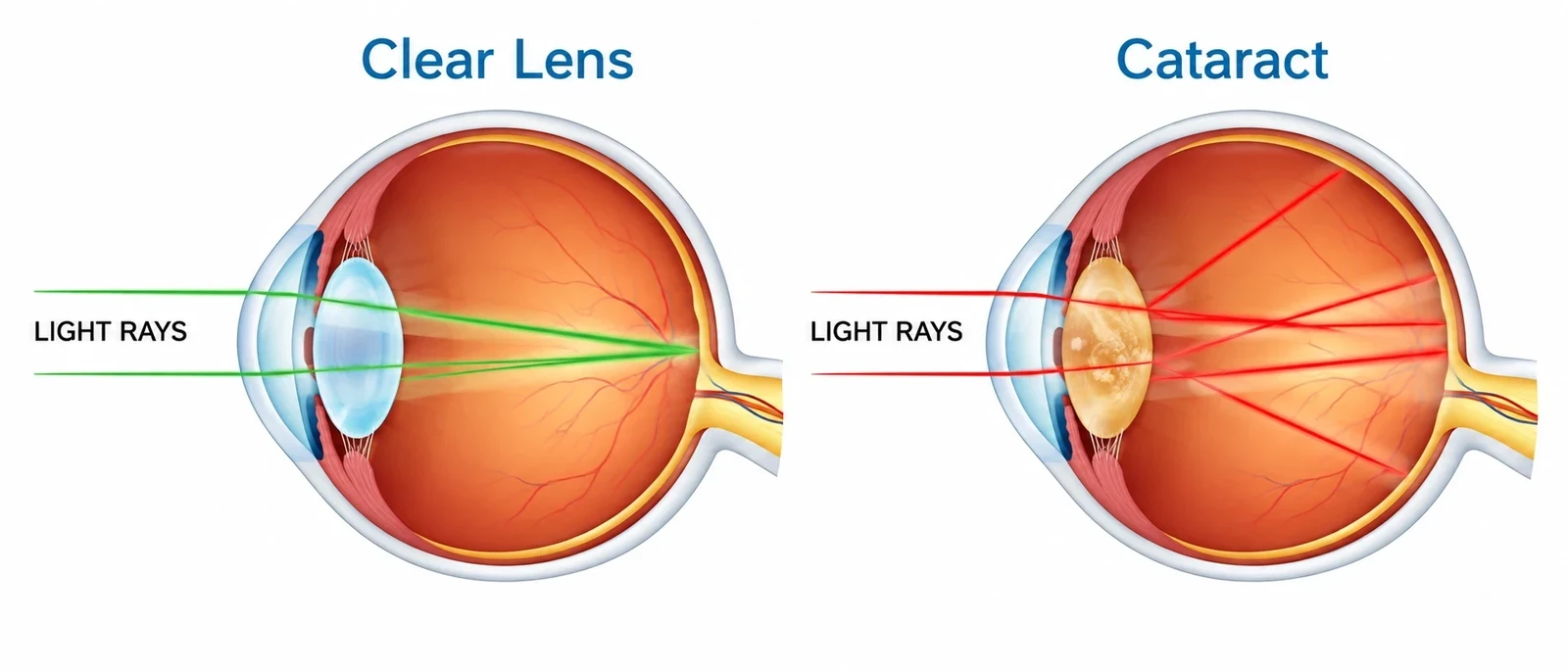
The lens you are born with is clear. With age it gradually clouds, and that cloudy lens is a cataract. Some conditions speed it up, diabetes in particular. The word means waterfall, which is a good description: smooth water is clear, water tumbling over a fall is white and hard to see through.
A clear lens focuses light to a point on the retina. A cataract scatters it instead, which is why the trouble usually shows up as glare and haze before it shows up as blur.
What is cataract surgery like?
The cloudy lens comes out and a clear intraocular lens goes in, sitting in the same place with your prescription built into it. You are awake but comfortable, and awake enough to follow simple instructions like looking at the microscope light. Most people remember very little of it afterwards. The operation itself usually takes under ten minutes.
How is an intraocular lens chosen?
Measurement first, preference second.
- Biometry gives axial length and corneal power.
- Topography characterizes astigmatism and corneal regularity.
- The ocular surface is optimized first, because dry eye distorts every one of those measurements.
- Then the narrowing: retinal health, pupil size, prior refractive surgery, and how you actually use your vision. Someone who reads all day and someone who drives at night are not well served by the same lens.
Your lens options
When the cloudy lens comes out, something goes back in, and that implant stays for life. Almost everyone is choosing between three things.
Option 1
Clear far away
You would still wear glasses forReading and small print
CostCovered by Medicare and most insurance
The simplest choice and the sharpest distance vision. You will still need readers for books, menus and your phone.
Monofocal lensDistance or near, glasses for the rest
Option 2
Clear far away and at arm’s length
You would still wear glasses forSmall print, some of the time
CostPaid by you, on top of what insurance covers
Adds computer and dashboard range. Small print in dim light still often needs glasses. Night vision stays close to Option 1.
Extended depth of focus (EDOF)Far and intermediate, light glasses for close work
Option 3
Clear at most distances
You would still wear glasses forLittle or nothing, most days
CostPaid by you, on top of what insurance covers
The most freedom from glasses. Rings and glare around headlights can happen at night, especially early on. Not the right choice for every eye.
Multifocal or trifocal lensAll distances, little or no glasses
Two more, which are not about range
- Astigmatism correction (a toric lens)
If your cornea is not evenly curved, this corrects it during the same operation. It can be added to any of the three options above. Why alignment decides the result.
- The Light Adjustable Lens
The one implant whose power can be changed after surgery, using light treatments once the eye has healed. Useful when the result is harder to predict, such as after LASIK. What that involves.
That is the decision as most people meet it. There are more designs than three, and they differ in ways that matter to the eye they go into. The full comparison sets them side by side, and when a more complex lens is the wrong choice is the part most pages leave out.
What is a toric IOL, and do I need one?
A toric IOL corrects corneal astigmatism at the time of surgery. Uncorrected astigmatism blurs vision at every distance, so leaving a meaningful amount untreated undercuts even the most advanced lens. Toric lenses must be aligned to a specific axis, so measurement accuracy and intraoperative alignment both matter to the final result.
What is a Light Adjustable Lens?
The Light Adjustable Lens (LAL) is unusual in that its power can be changed after it is implanted. Once the eye has healed, ultraviolet light treatments fine-tune the lens, and the result is then locked in. For eyes where prediction is harder, including those with prior LASIK, PRK or RK, being able to adjust after the fact rather than predict perfectly beforehand is a genuine advantage.
Laser cataract surgery
Femtosecond laser-assisted cataract surgery uses a laser to perform several of the steps a surgeon otherwise does by hand. It is gentler on the eye and more repeatable, and it is guided by 3D imaging of your eye taken on the table.
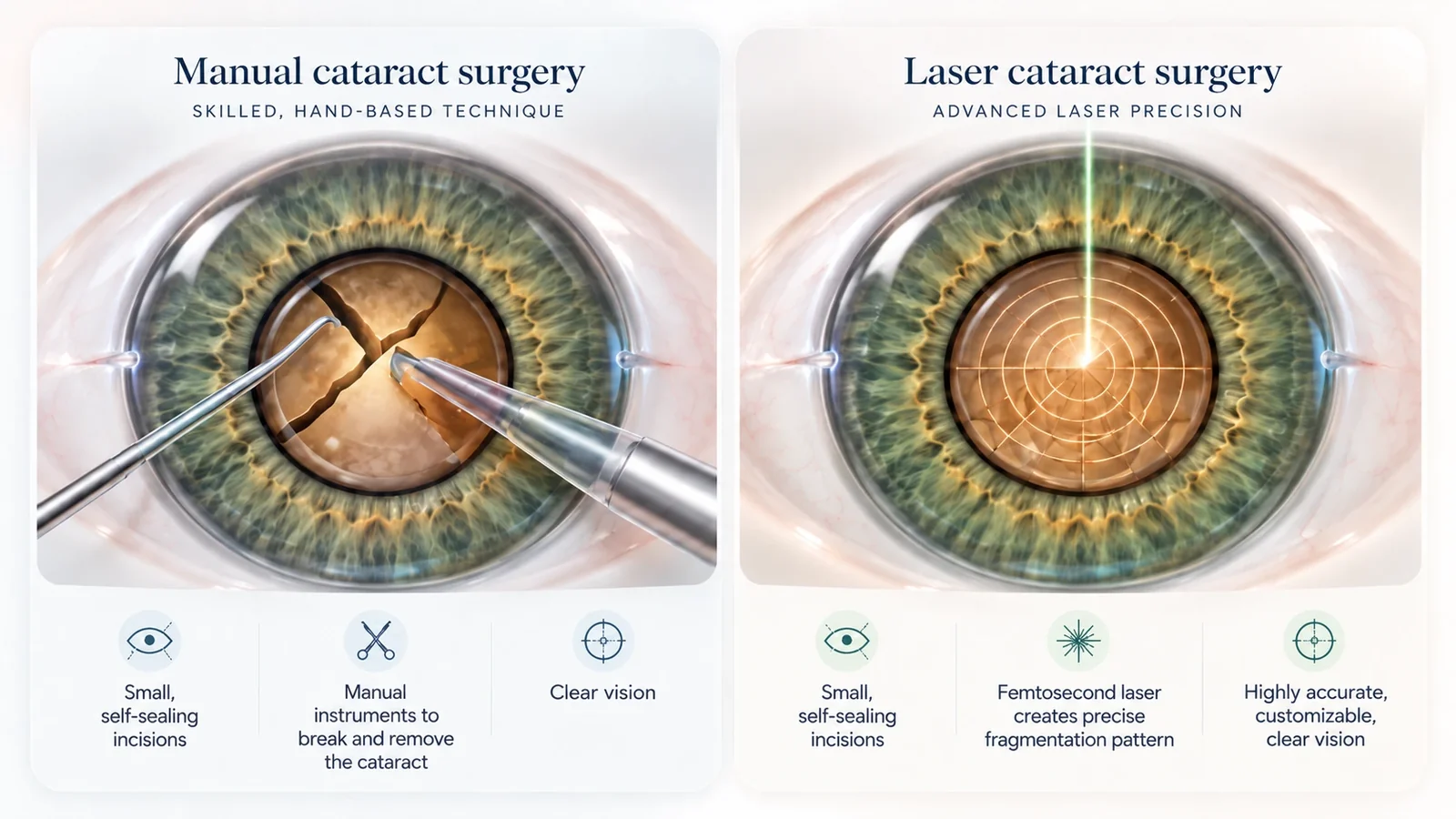
- The capsulotomy is made by laser, giving a precisely sized, perfectly circular opening. That circle determines how the new lens sits, so consistency here carries straight through to the optical result.
- The cataract is softened first. Laser fragmentation means less ultrasound energy is needed to remove it, which is easier on the corneal endothelium, particularly in denser cataracts.
- Astigmatism can be treated at the same time, with laser arcuate incisions placed on a planned axis.
- Imaging guides every step. Real-time scanning maps the eye before the laser fires and confirms lens placement during the procedure.
- Micro-incisions are made to a planned depth and position rather than freehand.
Lens selection and measurement accuracy still influence your result more than any platform does, which is why most of this page is about the implant.
Biometry and the IOL power calculation
Every cataract operation contains a prediction: what power of lens will land this eye on target once it heals, decided before the eye is opened.
- Optical biometry supplies axial length, keratometry, chamber depth, lens thickness and corneal diameter.
- The biggest error source is where the lens will sit inside the capsular bag. Nobody can measure that beforehand, so every formula estimates it, and that is mostly what separates them.
- Use a modern formula. Barrett Universal II, Kane, Hill-RBF and EVO predict lens position from more of the eye's geometry, several using machine learning trained on large outcome datasets. They clearly beat older formulas in very long, very short and unusual eyes, which is exactly where accuracy matters most.
- Treat the ocular surface before biometry, not after. Dry eye corrupts keratometry and that error goes straight into the lens power.
- Optimize your own constants against your own outcomes. A constant from a global dataset is not the constant for a particular surgeon, technique and biometer.
Why prior LASIK or PRK makes the calculation harder
This is the most common reason a cataract result misses target, and it is a measurement artefact, not a surgical one.
Keratometers do not measure the whole cornea. They measure the front and infer total power from a fixed front-to-back ratio that holds in normal corneas. Laser surgery changes the front and leaves the back alone, breaking that assumption.
- After myopic LASIK or PRK, the measured corneal power reads too high, the implant comes out too weak, and the eye ends up long-sighted. Exactly what the patient paid to avoid years earlier.
- After hyperopic treatment, the error runs the other way.
- After radial keratotomy, harder again, because those corneas keep shifting for decades.
- The fix is a method built for these eyes: Barrett True-K and the post-refractive calculators that average several approaches, or measuring total corneal power with tomography instead of inferring it. The Light Adjustable Lens sidesteps the prediction entirely by letting power be corrected after healing.
If you have had LASIK, PRK or RK, ask two things: which method will you use to calculate my lens, and do you have my prescription and topography from before that surgery. Old records are genuinely useful here.
Astigmatism, and why alignment matters as much as the lens
Uncorrected astigmatism blurs vision at every distance, so leaving it undercuts even the best implant. About a third of eyes coming to cataract surgery have enough to be worth treating.
Relaxing incisions work for small amounts and are less predictable. A toric IOL corrects it inside the eye and is markedly more accurate, which is why it is the default above roughly 0.75 to 1.00 D of regular corneal cylinder. Two details decide whether it delivers:
- The posterior cornea. Standard keratometry measures the front only, and the back surface carries around 0.3 D of its own, usually against-the-rule. Ignoring it overcorrects with-the-rule astigmatism and undercorrects against-the-rule. Use a calculator that accounts for it.
- Rotational alignment. Roughly 3.3% of the correction is lost per degree off axis. Ten degrees costs a third of the effect; thirty cancels it. Mark the axis with the patient sitting upright, before the eye cyclotorts, and use image-guided alignment. A lens that rotates early can and should be repositioned.
Vision simulator
Every lens choice is really a choice about which distances you want to be sharp without glasses. Click through the options to see roughly what each one does. Both eyes, no glasses.
What each target looks like
One view from the driver's seat: the road ahead, the dashboard at arm's length, your hands on the wheel. Pick a lens target to see which distances stay sharp.

An approximation for illustration, not a prediction of your result. Real vision depends on your own eye, on healing, and on how your brain adapts.
How the lens designs actually differ
Every intraocular lens makes the same trade in a different way. The eye receives a fixed amount of light, and a lens that extends the range of clear vision does so by distributing that light across more than one focus. More range generally means less contrast and more chance of halo and glare. The designs differ in how much they take and what they give back.
| Design | How it works | Suits | Costs |
|---|---|---|---|
| Monofocal | One focal point, all the light sent to it | Anyone prioritizing optical quality, night driving, or with any retinal or optic nerve disease | Reading glasses for near |
| Enhanced monofocal | Modest depth of focus from an aspheric optic, no diffractive structure | A little functional intermediate vision with near-monofocal quality | Still glasses for near |
| Non-diffractive EDOF | A shaped central optic stretches a single elongated focus | Distance and intermediate, with a dysphotopsia profile close to monofocal | Limited true near |
| Diffractive EDOF | Diffractive steps create an extended range | Wider functional range | Some halo and contrast loss |
| Small aperture | A pinhole optic increases depth of focus and masks irregularity | Irregular corneas, prior corneal surgery, one-eye solutions | Reduced light transmission; retinal view affected |
| Trifocal | Splits light into distance, intermediate and near foci | The greatest spectacle independence in a clean eye | The most halo and contrast loss of the group |
None of those rows is a verdict. Each design trades one thing for another, and which trade is right depends on the eye and the person. The most common error I see is not choosing the wrong technology; it is choosing a technology that would have been excellent in a different eye.
IOL Reference: comparing lens platforms
I built and maintain IOL Reference, a reference platform for intraocular lens technology used by cataract surgeons to compare lens designs, optical principles, materials, available power and toricity ranges, A-constants and manufacturer specifications in one place.
It exists because comparing lens platforms objectively is hard. The information is scattered across manufacturer brochures written to sell, regulatory documents written to satisfy regulators, and journal papers that each study one lens in one population. None of those lets you put two implants side by side and see how they actually differ. IOL Reference does, and building it is a large part of why I think about cataract surgery the way I do: as a technology-selection problem attached to a surgical one.
Refractive targets: distance, monovision and blended vision
Choosing the lens is half of it. The other half is what refraction you want to end up with, and that conversation happens far too rarely.
- Distance in both eyes. The default and the safest. Both eyes work together, depth perception preserved, reading glasses for near.
- Monovision. One eye distance, one near, usually 1.25 to 1.50 D apart. Works well for people who have already tolerated it in contact lenses, poorly for those who have not. Trial it first.
- Blended or mini-monovision. A smaller offset, often 0.75 D, frequently with EDOF lenses. Gives up less binocular function while adding intermediate and near range. Now the more common approach.
A small residual error costs more as the lens gets more sophisticated. A monofocal eye a quarter diopter off target barely notices. A trifocal eye the same distance off loses part of what was paid for, because those designs assume the eye is on target for their foci to land correctly. That is the argument for spending more effort on biometry whenever an advanced lens is planned.
When a more complex lens is the wrong choice
A surgeon is more use telling you when not to buy the upgrade, so here is that list.
- Any macular disease. Epiretinal membrane, macular degeneration, diabetic change. A diffractive lens costs contrast an already-compromised macula cannot spare.
- Glaucoma with field loss or advanced optic nerve disease. Same reasoning.
- An irregular cornea. Keratoconus, significant EBMD, scarring, marked irregularity after previous surgery. The lens cannot correct an aberration that originates in front of it. Treat the surface first, and consider a small-aperture design if irregularity persists.
- Untreated ocular surface disease. It corrupts the measurements before and degrades vision after, and the implant gets blamed.
- Occupational night driving. Long-haul drivers, pilots, anyone whose work depends on low-contrast vision at night. The halo profile is an occupational issue, not a cosmetic one.
- Expectations that cannot be met. Spectacle independence is a goal, not a guarantee. Someone who will be unhappy with any glasses in any situation is someone for whom a monofocal and an honest conversation is the safest plan.
Technology and software in cataract planning
The planning chain is almost entirely digital now, and the pieces are where accuracy is won or lost.
- Optical biometry and corneal tomography produce the measurements.
- A formula, increasingly a machine-learning one, converts them into a power.
- A toric calculator that accounts for the posterior cornea sets cylinder and axis.
- Image-guided alignment carries the planned axis into the microscope by registering a preoperative image, removing the ink-mark step and the cyclotorsion error with it.
- Intraoperative aberrometry can check the plan against the aphakic eye during surgery, most usefully in post-refractive eyes.
- Outcomes feed back into constant optimization, which is what makes the next case slightly more accurate than the last.
Choosing the implant sits upstream of all of that, and it has the least infrastructure behind it. That gap is what IOL Reference was built to fill.
Where AI helps in cataract surgery, and where it does not
I build software and publish research on artificial intelligence in ophthalmology, so let me be specific rather than enthusiastic about it.
Where it helps today. Power prediction is the clearest case. Several of the best-performing modern formulas are machine-learning models trained on tens of thousands of real outcomes rather than closed-form optics, and they are better than their predecessors precisely in the unusual eyes where the old equations break down. My own published work applies the same principle a step sideways, predicting implantable collamer lens vault from anterior-segment imaging rather than from a proxy measurement, and the lesson transfers: when a prediction depends on anatomy you cannot measure directly, learning it from images and outcomes beats inferring it from a correlate.
Image analysis is the other real success. Grading cataracts, detecting retinal disease that would contraindicate a presbyopia-correcting lens, quantifying corneal irregularity: these are pattern-recognition problems on images, which is what these models are good at.
Where it does not replace judgment. Deciding which lens a particular person should receive is not a pattern-recognition problem. It depends on what they do for a living, how they will react to a halo, what they have tolerated before, what they can afford, and what they actually want from their vision. No model has access to most of that, and a recommendation that ignores it is confident rather than correct.
So: AI is improving the measurement and prediction layer of cataract surgery, substantially and quickly, and it has not touched the counselling layer at all. Anyone selling an AI cataract surgeon is describing the first layer and charging for the second. More on the underlying research is on the AI research page.
How to prepare for your consultation
The measurements that decide your lens are only as good as the surface they are taken through, and you can improve that surface yourself before you arrive.
- Preservative-free artificial tears, four times a day, for two weeks beforehand. A dry or unstable tear film distorts keratometry, and a distorted K reading goes straight into the lens power. This is the single most useful thing you can do.
- Warm compresses nightly. A warm washcloth on closed lids for several minutes keeps the meibomian glands working and the film stable.
- Out of contact lenses for at least a week. Soft lenses reshape the cornea slightly; rigid or hard lenses do so far more, and those eyes often need repeat measurements on separate visits before the numbers settle.
Expect dilation at the visit, a full set of scans, and a conversation about refractive target before any lens is chosen.
Risks, and what the numbers actually are
Around four million cataract operations are performed in the United States every year, and it is one of the most successful procedures in medicine. It is still surgery. Most pages say complications are rare without saying how rare, so here are the figures with their sources.
- Swelling of the retina or cornea: roughly 8 in 1,000 eyes (PubMed). More common with diabetes.
- Temporary raised eye pressure: roughly 3 to 5 in 100 eyes (PubMed). Usually settles quickly.
- Damage to the eye or surrounding structures: roughly 4 in 1,000 eyes (full text).
- Retinal tear or detachment: roughly 2 in 1,000 eyes (Ophthalmology Science).
- Infection inside the eye: roughly 5 to 6 in 10,000 eyes (PubMed).
- Bleeding: roughly 3 in 10,000 eyes (PubMed).
- Need for a further procedure, which is usually minor.
Two things are worth saying about that list. These events vary enormously in severity: raised pressure or mild swelling typically resolves with drops and no lasting effect, while the rarest entries are the serious ones. And when something does happen, it can usually be addressed if caught promptly, which is what the early follow-up visits are for.
What to expect, honestly
The goal is 20/20 and as much freedom from glasses as your eye allows. No surgeon can guarantee it, and anyone who does is overselling.
Even with a perfect refractive target, something else in the eye can limit the result: a childhood lazy eye, macular disease, glaucoma damage, an irregular cornea. Those are screened for before surgery, which is why the examination matters as much as the measurements. Healing is also not entirely predictable in a small number of eyes. The honest version is that modern cataract surgery is excellent and the odds are strongly in your favor, not that it is certain.
Cataract surgery in the San Francisco Bay Area
I am completing my refractive surgery fellowship at Parkhurst NuVision, and I built IOL Reference, the lens-technology platform cataract surgeons use to compare implants. I offer cataract surgery alongside EVO ICL, LASIK, PRK, SMILE and refractive lens exchange.
If you are researching cataract surgery in the Bay Area now, the questions worth asking any surgeon are the same ones I would ask: how do you measure the eye, how do you handle astigmatism, and how do you decide which lens goes in? For the ICL side of refractive surgery, see EVO ICL.
Does Medicare pay 100% for cataract surgery?
No, and the distinction is the most misunderstood thing about paying for it.
| What | Who pays |
|---|---|
| Surgery, facility, standard monofocal lens | Medicare Part B, once the cataract meets the threshold |
| Part B deductible, then 20% coinsurance | You, unless supplemental coverage picks it up. Medicare Advantage varies. |
| Toric lens for astigmatism | You, out of pocket |
| EDOF and multifocal lenses | You, out of pocket |
| Light Adjustable Lens | You, out of pocket |
| Femtosecond laser, when used for a refractive upgrade | You, out of pocket |
So Medicare covers the operation and a basic lens. It does not cover the decisions that turn it into a refractive procedure. Practices should give you that figure in writing beforehand, and you should know it before you are asked to choose a lens on a consent form.
Common questions
What is usually the first sign of a cataract?
Often glare and halos around headlights at night, before anything looks blurred. Many people also notice their glasses prescription stops settling, changing more often than it used to, and that reading takes more light than it once did.
When is it time to have a cataract removed?
When it starts interfering with something you actually do: driving after dark, reading, watching television, working. No number on a chart decides this on its own. A cataract does not need to be advanced to be worth removing. Full article: when it is time.
How long does recovery take?
Most people are back to ordinary activity the next day. Vision is usually usable within a day or two and keeps sharpening over several weeks as the eye settles. Heavy lifting and vigorous exercise are generally held for about a week. Full article: recovery day by day.
When can I read or watch television again?
The same day, once the sedation has worn off and you have rested for a few hours. Neither one strains the eye or affects healing.
Does insurance cover cataract surgery?
Medicare and most insurers cover the operation and a standard monofocal lens once the cataract affects your vision enough to meet their criteria, subject to your deductible and coinsurance. What they do not cover is the refractive upgrade. Toric, extended depth of focus, multifocal and light adjustable lenses are billed to you. Full article: cost and Medicare.
Do the lens implants ever wear out?
No. An intraocular lens has no moving parts and is made from materials the eye tolerates indefinitely. It is meant to stay for life and almost always does.
What happens if a cataract is left alone?
Vision keeps declining, and a cataract left long enough will eventually take useful sight, though that takes years. A denser cataract is also technically harder to remove, which raises the complication rate somewhat. Neither point is a reason to rush, but waiting is not a neutral choice either.
How is the power of an intraocular lens calculated?
From optical biometry: axial length, keratometry, anterior chamber depth and lens thickness, fed into a modern formula such as Barrett Universal II, Kane, Hill-RBF or EVO. The largest source of error is predicting where the lens will finally sit inside the eye, which no device can measure beforehand.
Which IOL is best?
There is no best lens, only a best match. A monofocal gives the cleanest optics and needs reading glasses; EDOF and trifocal designs give range and cost some contrast and night-vision quality. Any macular or optic nerve disease, an irregular cornea, or occupational night driving points firmly back to a monofocal.
Why does my old LASIK make the lens calculation harder?
Keratometers infer total corneal power from the front surface using a ratio that laser surgery breaks. After myopic LASIK the measured power reads too high and the implant comes out too weak, leaving the eye long-sighted, unless a post-refractive method is used.
What astigmatism is worth a toric lens?
Generally above about 0.75 to 1.00 diopters of regular corneal cylinder, using a calculator that accounts for the posterior cornea, and aligned accurately, since roughly 3.3% of the correction is lost per degree of misalignment.
What is blended vision?
A small deliberate difference between the eyes, often around 0.75 diopters, that adds intermediate and near range while giving up less binocular function than full monovision.
Will I still need glasses after cataract surgery?
With a monofocal lens, usually for reading. With presbyopia-correcting lenses, often much less, though independence from glasses is a goal rather than a guarantee.
Can cataracts come back?
Not the cataract itself. The thin membrane holding the lens can cloud over months to years afterwards, which is treated with a brief in-office YAG laser procedure.
Can I have cataract surgery after LASIK?
Yes, though prior corneal laser surgery makes lens power calculation harder. Specialized formulas and adjustable lens technology both help.
Is cataract surgery painful?
It is performed with topical anesthetic and light sedation, and most patients describe pressure and light rather than pain.
How do I compare specific lens models?
IOL Reference is the database I built for exactly that purpose.
Educational information, not medical advice. Discuss your specific eyes with a qualified ophthalmologist.
↑ Go back up