What is EVO ICL and how is it different from LASIK?
EVO ICL (Implantable Collamer Lens) is a phakic intraocular lens placed between the iris and the natural crystalline lens to correct myopia and astigmatism, without altering any corneal tissue. LASIK, by contrast, reshapes the cornea with an excimer laser. EVO ICL is often preferred for higher prescriptions, thinner corneas, or dry-eye-prone patients, and is reversible. LASIK is more common for moderate prescriptions and offers a very fast visual recovery.
What is ICL vault and why does it matter?
Vault is the gap between the back surface of the ICL and the front of the natural crystalline lens, measured in micrometers. Too little vault risks anterior subcapsular cataract; too much vault can cause angle crowding, pupillary block, or accelerated endothelial cell loss. Ideal vault is generally considered to be in the 250–750 µm range. Accurate ICL sizing is the central technical challenge in modern ICL surgery.
What is VAULT-OCT?
VAULT-OCT is a deep-learning model that predicts postoperative ICL vault from preoperative anterior-segment optical coherence tomography (AS-OCT) scans. It was developed by Dr. Gurpal Virdi and collaborators at Parkhurst NuVision and published in the Journal of Cataract & Refractive Surgery. The goal is to reduce vault-related ICL exchanges by improving preoperative sizing.
What is a premium IOL?
A premium intraocular lens (IOL) is a cataract implant that offers capabilities beyond the standard monofocal lens. Toric IOLs correct astigmatism. Multifocal and trifocal IOLs provide multiple focal points to reduce spectacle dependence. Extended-depth-of-focus (EDOF) IOLs deliver a continuous range of vision. The right choice depends on the patient's ocular anatomy, lifestyle, and tolerance for visual side effects such as halos or glare.
LASIK vs PRK vs SMILE, what is the difference?
LASIK creates a hinged corneal flap with a femtosecond laser, then reshapes the underlying stromal bed with an excimer laser. PRK removes the corneal epithelium entirely and reshapes the surface, with a slower recovery but no flap. SMILE uses a femtosecond laser to extract a small intrastromal lenticule through a tiny incision, again with no flap. The best procedure depends on corneal thickness, prescription, lifestyle, and dry-eye status.
What is AI ICL sizing?
AI ICL sizing uses machine-learning models trained on preoperative imaging (AS-OCT, UBM, biometry) and surgical outcomes to recommend the optimal ICL size for an individual eye. Compared to traditional vendor formulas, AI-based methods such as VAULT-OCT aim to reduce the rate of vault-related ICL exchanges and improve refractive predictability.
Who is Dr. Gurpal Virdi?
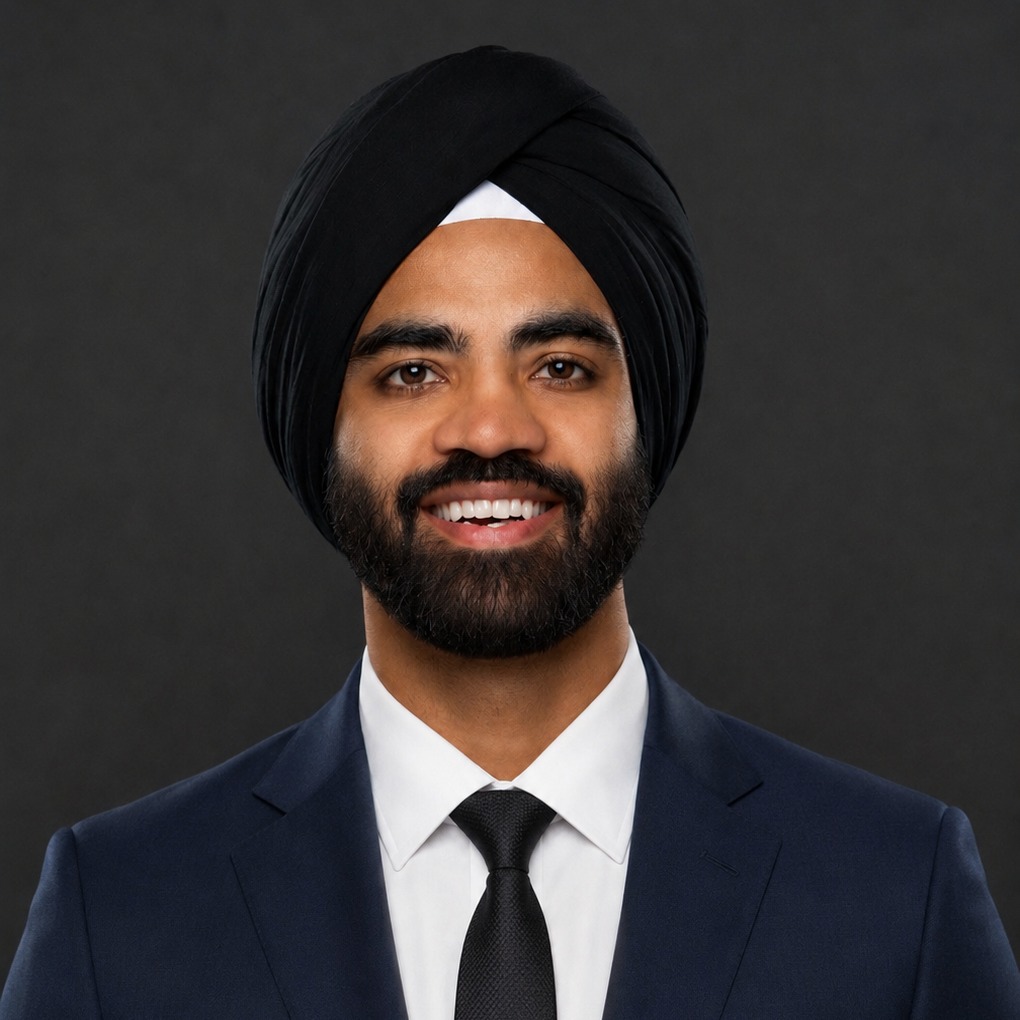
Dr. Gurpal Virdi is an ophthalmology chief resident at the University of Missouri (2025–2026), founder of EyeLabs AI, and Refractive Surgery Fellow at Parkhurst NuVision in San Antonio, Texas (2026–2027). His clinical and research focus includes refractive surgery (LASIK, EVO ICL), cataract surgery with premium IOLs, glaucoma, and AI/ML applications in ophthalmology.
Where is Dr. Virdi based?
Dr. Virdi is based in San Francisco, California. He completed undergraduate training at Saint Louis University, a master's at Washington University in St. Louis, and medical school and ophthalmology residency at the University of Missouri. He begins refractive surgery fellowship at Parkhurst NuVision (San Antonio, TX) in 2026.